
 Statement on Motion to Vacate in U.S. v. Florida
CommunicationFIRST is alarmed by the U.S. Department of Justice’s (DOJ) decision to reverse course in United States v. Florida, a case the Department itself brought and won to protect children with complex medical needs—including many children with speech-related disabilities—from unnecessary institutionalization.
The case concerns Florida’s failure to provide children with complex medical needs the community-based services they need to live safely at home, including in-home nursing care. Without those services, many children in Florida were instead unnecessarily placed in nursing facilities away from their families, while others remained at serious risk of institutionalization. A federal court found in 2023 that Florida’s administration of its Medicaid program violated the Americans with Disabilities Act (ADA) and required the state to provide the services necessary to keep children in the community.
That federal court ruling has since made a big difference in the lives of children. Florida has taken key steps toward improving access to the services children need to remain at home and in their communities, where they belong.
But now, the DOJ has decided to interpret the ADA differently. Earlier this summer, it released a memorandum saying that it now believes that the ADA does not actually protect the right of disabled people to live in the community. It is now asking a court to “vacate” (cancel) the U.S. v. Florida decision, arguing that children with disabilities who are “at risk” of institutionalization—but haven’t yet been forced into a nursing home—aren’t protected by the ADA’s protections against unnecessary institutionalization, as set forth by the U.S. Supreme Court in its 1999 Olmstead decision. This is at odds with the law, and the consequences for children may be severe.
Separation from family members and loved ones is traumatic for any child. For a child with complex medical needs, it is terrifying.
These separations make it harder for loved ones to act as medical advocates on a day-to-day basis, which could have life-threatening consequences. And for children with speech-related disabilities, the risks can be especially acute. Parents, siblings, and familiar caregivers may have spent years learning how a particular child communicates pain, discomfort, fear, hunger, distress, consent, new symptoms, or an urgent medical need. Staff at nursing homes who are unfamiliar with children’s communication may not notice when symptoms change or when a child is in need of help. They may not even interpret certain actions by the child as attempts to communicate.
Jade Quinones, an augmentative and alternative communication (AAC) user who was forced into a Florida nursing home as a child, reported that she was often left in soiled clothing and that she feared for her life while waiting for a nurse to help her after her tracheal tube became dislodged. The court also described Jeffrey, a medically complex child who was institutionalized for approximately 16 months after his family was unable to obtain adequate in-home nursing. When he was first taken to a nursing facility, the separation from his grandmother triggered a severe panic attack that required a month-long hospitalization. While institutionalized, Jeffrey’s health declined, he was repeatedly hospitalized, and his grandmother feared that he could not communicate with staff.
The federal court concluded in the Florida case that “[a]ny family who wants to care for their child at home should be able to do so.” Even a temporary or threatened nursing home placement can have life-altering or life-threatening consequences and be traumatizing to everyone in the family.
CommunicationFIRST calls on the Department of Justice to withdraw its motion to vacate the federal court’s decision in U.S. v. Florida and to defend the right of disabled children to remain with their families and in their communities.
We also call on Florida Governor Ron DeSantis, Attorney General James Uthmeier, the Florida Agency for Health Care Administration, and other state officials to commit to continuing the work they’ve already done to help children stay at home.
Questions may be directed to CommunicationFIRST Director of Policy & Legal Advocacy Sam Crane or Executive Director & Legal Director Tauna Szymanski at info@communicationfirst.org.
Download post in PDF form. Access post as a Google Doc.
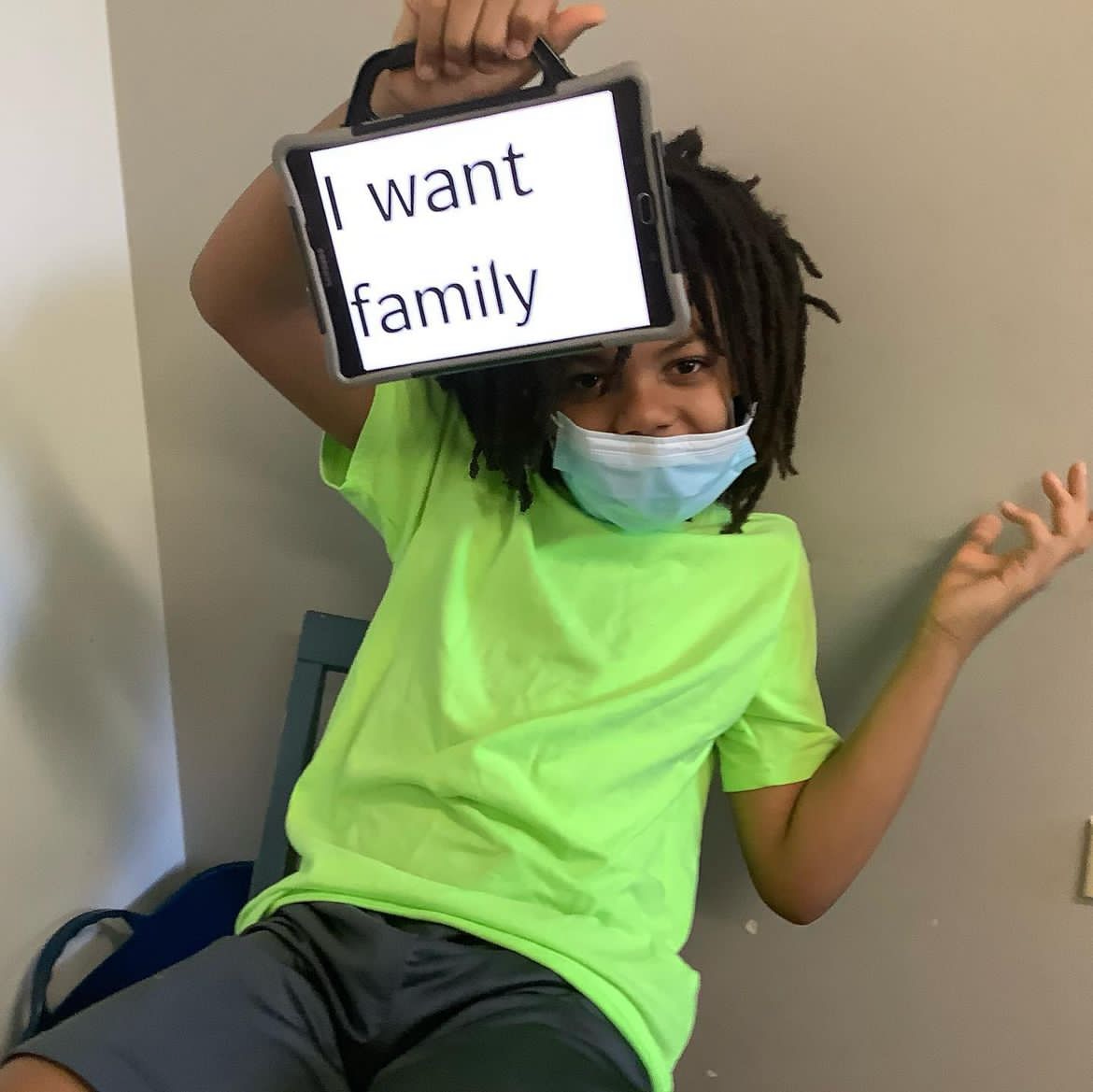
Image Description and Credit:
A young boy wearing a mask holds up a speech generating device with the sentence, "I want family." #VisibleAAC photo submitted by Jill Tullman.