

CommunicationFIRST Program Manager Marrok Sedgwick and CommunicationFIRST Board member Lateef McLeod both earned Ph.D. degrees in 2024 after completing dissertations on topics related to augmentative and alternative communication (AAC). Both are also AAC users. In the transcribed interview that follows, Marrok asks Lateef about his research and what the process of earning his degree was like. The interview, which took place in June 2025, has been edited lightly for readability.
Marrok: What insight do you think you had as an AAC user and anthropologist that anthropologists who are not AAC users would not have had?
Lateef: Well, for my topic for my dissertation, I did my research on how AAC users engaging in mentorship partnerships with each other can develop their self-advocacy and leadership skills. Because of these positive mentorship interactions, with my particular field research, my identity as a person who uses AAC gave me insight into why mentorship was important to people who use AAC.
I also constructed my field research so that people who use AAC can easily participate in a field research interview over Zoom or WebEx and have enough time to formulate their responses. Also, all the material that I wrote in my dissertation were reviewed by the people who use AAC that I interviewed, so I really wanted to make sure that I captured their point of view for the project.
Marrok: That is excellent. I’m glad you mentioned that you asked the people you did your research with to review your work. That is so important.
What are the most important things you learned through your research?
Lateef: I learned that the disability community, and more specifically the AAC community, are important if we want to fully embrace our identities as disabled people and people who use AAC. I fully believe that we have role models to look up to and emulate, and also a group of people to identify with, but then also to support each other.
This is what I saw with my field research: how people who use AAC form communities to mentor and support each other.
Marrok: That is great insight.
If someone wanted to start a peer mentoring program for AAC users, what advice do you have for them?
Lateef: My advice for people who want to start a peer mentoring program for people who use AAC is to organize people around activities that they are interested in, engaged in, and to build the structure of the mentoring program around those shared liked activities.
Marrok: That is an excellent idea.
You have extensive experience as a poet and performer focused on disability justice. How did that expertise inform your research?
Lateef: In my dissertation, I specifically incorporated the disability justice principles into my research and illustrated how the principles can be seen and how the AAC mentoring programs are organized. I also added two of my poems to my dissertation to add an artistic emphasis to my thesis.
Marrok: You just mentioned applying the disability justice principles to the peer mentoring program. I am thinking there may be people who read this interview who are not yet familiar with disability justice principles. Could you describe what those are and maybe give an example of how you have applied one of the principles to mentorship?
Lateef: Okay, so there are 10 principles like Intersectionality, Leadership of the Most Impacted, Anti-Capitalism, Collective Access, among others. And in my dissertation I pointed out how the mentor programs utilize these principles, like Collective Access, and made sure that the people in the group had their access needs met.
Marrok: The disability justice principles are a great way to start out a peer mentorship program. Hopefully we will see more programs that use those principles.
Lateef: Yes, definitely.
Marrok: How would you like to see your research applied in the future?
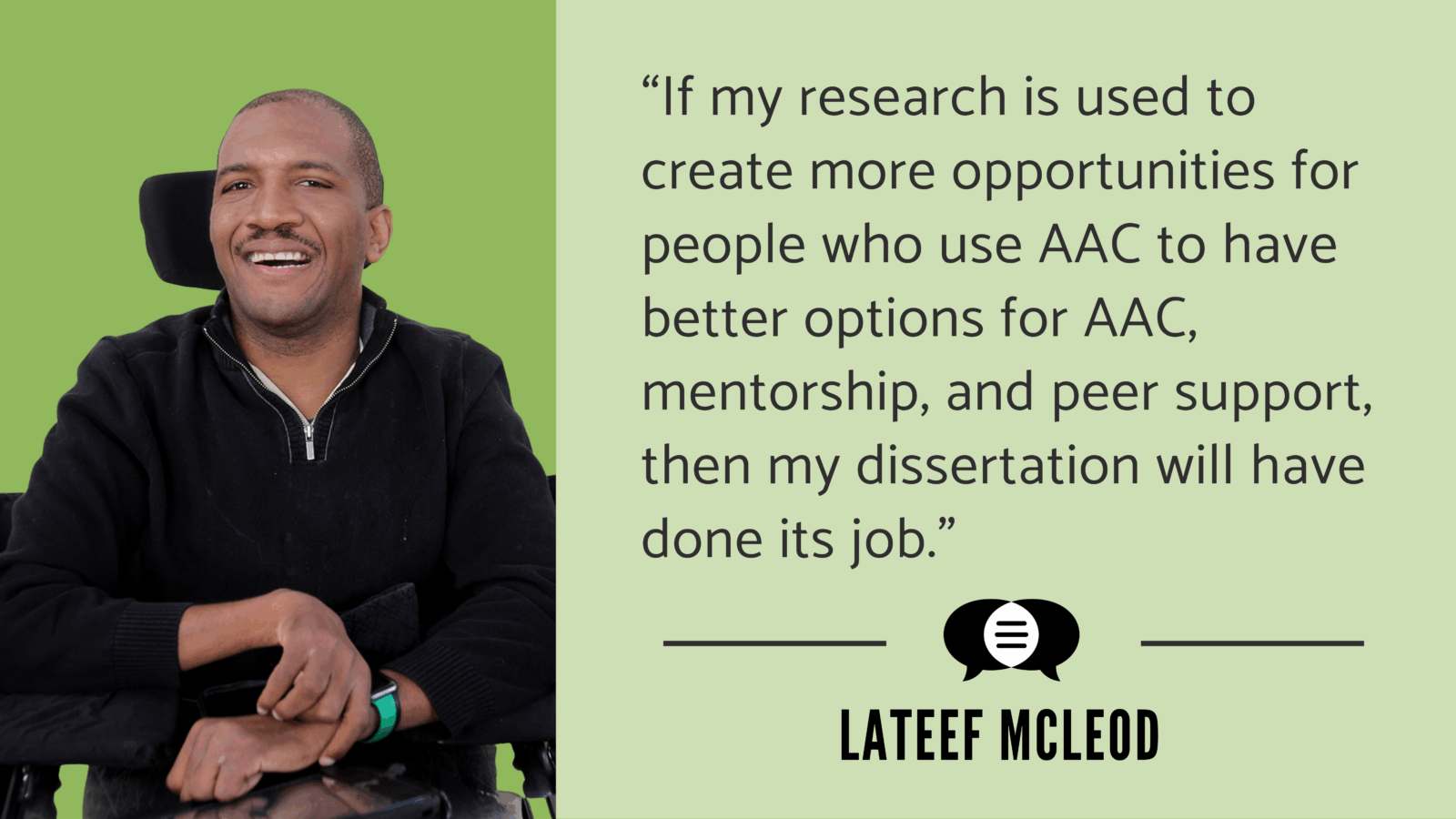
Lateef: If my research is used to create more opportunities for people who use AAC to have better options for AAC, mentorship, and peer support, then my dissertation will have done its job.
Marrok: I hope lots of peer support programs for AAC users grow out of your dissertation.
Based on what you learned, what changes would you like to see for our community and beyond?
Lateef: It will be good for the disability community to have more opportunities to provide mentorship and peer support to each other to strengthen our community. PeoplesHub provides this community building space in their care clinics.
Marrok: Can you say more about PeoplesHub and their care clinics?
Lateef: Yes. I don’t know if they are weekly or biweekly, but they are a chance for disabled people to come online and check in with each other and offer each other support.
And I also have to say that I just was involved with the comprehensive report evaluating AAC peer support programs for my job at Oregon Health and Science University, and we are hoping for positive outcomes for that as well.
Marrok: Both sound like very important projects. I look forward to learning more about them and reading the comprehensive report.
Lateef: Yes, the report is out for people to read.
Marrok: I will definitely look at it!
What’s next for you? Are you extending this research in any way?
Lateef: I was thinking of expanding my research into a book on how disability peer support builds community.
Marrok: I would love to read that book and share it with other people too.
Lateef: Thank you.
Marrok: Do you have any advice for AAC users who might be interested in pursuing a Ph.D.? Did you come up with any solutions to AAC-related access needs that they might want to use?
Lateef: My advice is to choose an area that they really are interested in and engage in for their research because it is a lot of work. For solutions, I am not sure. Maybe AI [artificial intelligence] can assist in the extensive amount of typing you need to do for a dissertation.
Marrok: That is a good point. I know for my dissertation, I spent many hours every day for several months just on typing.
Lateef: Yes, me too. And it was laborious.
Marrok: I agree.
I have really enjoyed meeting you today. Thanks so much for answering my questions. I look forward to sharing our discussion on the CommunicationFIRST blog, so others can learn about the important work you have done and continue to do.
Lateef: Yes. Thank you, Marrok. So before you go, what was your dissertation on?
Marrok: My dissertation was about the epistemic practices that non-speaking autistic students with an additional diagnosis of intellectual disability use during forest and beach walks. Epistemic practices are whatever things we do to try to understand the world. For example, a laboratory scientist like a chemist might use experiments as one type of epistemic practice.
In my dissertation, I followed the students during walks at forests and beaches, and learned from them how they use stimming and walking with sand and logs, and anything else they find, to make sense of the world. In many ways, stimming became like the chemist’s experiment.
Lateef: That is awesome and intriguing. I would like to read it sometime.
Dr. McLeod’s Ph.D. was in the field of Anthropology and Social Change from the California Institute for Integral Studies in San Francisco. Dr. McLeod’s research extended his own experiences as a lifelong AAC user working in the disability justice movement. A video recording of Dr. McLeod presenting a summary of his dissertation findings to the Augmentative and Alternative Communication (AAC) Peer Support Project’s Consortium of AAC users can be accessed here.
Download post in PDF form here.
[Image description: Lateef McLeod smiles at the camera. Next to his image it says, “If my research is used to create more opportunities for people who use AAC to have better options for AAC, mentorship, and peer support, then my dissertation will have done its job. Lateef McLeod.” Above Lateef’s name is the CommunicationFIRST logo.]