
 CommunicationFIRST Program Manager Marrok Sedgwick and CommunicationFIRST Program Associate Ren Koloni are both multiply disabled AAC users who hold advanced degrees. In March 2026, Marrok interviewed Ren about their experience as an AAC user pursuing a master’s degree at George Washington University focused on disability and racial justice. The interview has been edited lightly for readability.
Marrok: The average person does not have a graduate degree, and many people aren’t sure what a graduate degree is. Can you briefly explain in plain language what a graduate degree is, and why a person might want one?
Ren: Elementary and middle school should teach people basic knowledge about the world. High school should help people learn the skills they need to ask more questions and find out the answers. From there, there are lots of options to be a part of the world we live in. Some people work or volunteer, some get trained in a trade, and some keep going to school.
When someone says they’re going to college, they usually mean they’re getting an undergraduate degree. It might be an associate’s degree (which takes two years), or a bachelor’s degree (which takes four).
Humans have been learning things for thousands of years. In undergraduate, you learn more about parts of the world that you’re interested in. This is helpful for so many paths in life. You can use the knowledge that humans have already gathered to do your work well.
When you get a graduate degree, you ask yourself, “What do we still need to understand about this part of the world? How can I be a part of the conversation?” (It’s also an excellent excuse to keep being in school, if that’s something you really love, like I did.)
Of course, this is a very hopeful answer. A lot of people don’t learn what they need or want to know at any time in school, and a lot of people go to college or graduate school because they feel like they have to, not because they want to. Sometimes, you can get better jobs or get paid more because you have a certain degree. I was very privileged to be able to keep going to school simply because I wanted to keep learning.
Marrok: Disability Studies has two branches: one focuses on the humanities (English, art history/criticism, etc.), and the other on the social sciences (anthropology, sociology, education, etc.). What made you decide to focus on the humanities side as opposed to the social sciences side?
Ren: My undergraduate training was actually in sociology! I was a double major (meaning that I took the right classes to get two degrees) in sociology, and in women’s and gender studies. I mostly focused on disabling chronic illness, especially as it was a part of the lives of women and/or transgender and gender non-conforming (TGNC) people. One of my mentors was herself a survivor of both cancer and the cancer industry, and working with her was one of the things that pushed me to become critical of the way chronically ill people—who are overwhelmingly women and/or TGNC—get treated, how we get marginalized even within science and institutions that say they’re trying to help us.
At the same time, I was also becoming more and more active in the autistic community. As a latecomer, I had a lot to catch up on! I was realizing that autistic people disproportionately have these experiences with chronic illness, too, often amplified further by other disabilities (like communication disability) or other aspects of their lives, like racialization or poverty. Gradually my interest started shifting from “how does gender impact the way we’re treated when we’re sick?” to “how does disability impact the way we’re treated when we’re sick?”
What I found is that nobody in the sciences was answering that question in a way that satisfied me. They did not seem to be trying to look at the world the way we see it as disabled people. They did not seem to have the same love for disabled life that I did. As I started putting out feelers for like-minded crips and disabled people, I found that people had been doing exactly the work I wanted to—and they were often doing it in the humanities. I switched over to a more humanities-heavy schedule in my last year and a half of undergraduate, focusing on sociolinguistics and social justice in contemporary literature, and made the decision to apply to the English program at George Washington University in DC—well-known for its disability studies and queer studies focuses.
Marrok: Can you tell us about your master’s program? What was your focus?
Ren: I described my focus as “the art of surviving and thriving on the margins.” I was looking at the intersections of gender, racialization and colonization, and disability, and trying to map out the ways that we in these intersections could live through intense trauma and still love life. Racialization and colonialism always intersect with disability and vice versa, and gender is tangled up in everything, so I was never just studying one thing by itself.
A lot of people think of an English degree as focusing on literature, and I did read a lot of literature, especially by Black women writers who wrote a lot about trauma, like my favorite author, Toni Morrison. But a lot of my work was actually with history, and with contemporary disabled writers—people like Mel Baggs, Eli Clare, Leah Lakshmi Piepzna-Samarasinha, Mia Mingus, Alice Wong, and others who have shaped disability justice.
I wrote papers all over the map. I wrote about disability and illness in the apocalypse as portrayed by video games. I wrote a plain language paper about the colonization of Latinoamérica (more on that later in this interview!). I even got to interview Cal Montgomery for a paper about autistic burnout and how to respond to it.
Marrok: Do you have a favorite paper you’ve written?
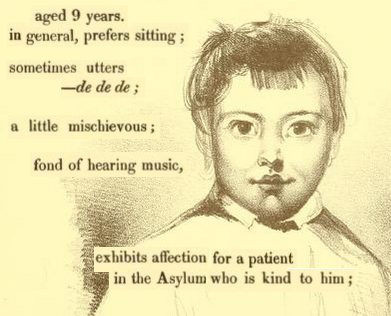
Ren: My absolute favorite paper was an accident. I had been reading through the Medical Heritage Library collections on the Internet Archive, because despite everything, I’m still a medical sociologist at heart, and I stumbled across an old book from 1843 called The Physiognomy of Mental Diseases. Physiognomy is a completely nonsense idea that you can tell what’s “wrong” with people by looking at their appearance—though, of course, this is something most chronically ill or psychiatrized people in this day and age still encounter all the time. But there was something odd about this book. It was full of illustrations of people who were institutionalized, with short descriptions of each person attached. And that was what made it so interesting to me: these descriptions acknowledged, like nothing else did in 1840s psychiatry, that people in institutions—many of whom would have had little or no access to communication—were people, with thoughts and preferences and feelings. It was one of the most humanizing histories of my ancestors I had ever seen.
I had also just read Saidiya Hartman’s 2008 book Lose Your Mother: A Journey Along the Atlantic Slave Route. In it she tries to tell “an impossible story.” She takes the very limited historical stories we have of the people who were dragged from their homes in Africa and forced into chattel slavery across an unforgiving ocean, and expands it into detailed, living, breathing narrative. This was a whole book laying out the methods for finding and honoring personhood in a historical archive of people who were treated with unspeakable violence, who were silenced, othered, and dehumanized. I applied those methods to this 1843 book I had discovered about institutionalized people, with the faces of my ancestors in its pages. I imagined what it would be like to reach across time and meet them, to speak with them on their own terms, and tell them that, even hundreds of years later, someone was thinking of them.
This is a crucial part of disability justice work, at CommunicationFIRST and everywhere else: we gaze back into time and tell the people we never had the chance to know that they are honored and not forgotten.
Marrok: Did you have a master’s thesis, Ren?
I actually didn’t have a thesis. One of the things I loved about my program was a willingness to do things differently. As I was getting sicker, I was getting less and less able to do things the “normal” way, so the option of a capstone reflection gradually became my only choice. I chose a few of my favorite papers from my time in the program and wrote an essay reflecting on what I’d done well, what I wanted to change, and where I wanted to take my ideas going forward. What I learned from that reflection is that I didn’t really have or want a specific focus, like many of my peers did. I liked following my curiosity. And I’m very lucky that I’ve been able to do that here at CommunicationFIRST, too, because we work on so many different topics. There is always more to learn!
Marrok: Do you think a bachelor’s or master's is structurally more accessible than the other? If so, what features enhance accessibility, and what features reduce accessibility?
Ren: I found my master’s degree to be more accessible than my bachelor’s, but a lot of that had to do with the professors I had and the situation I found myself in. COVID-19 hit the United States in early 2020, which meant I got to do the last year and a half of my degree virtually. I would not have been able to graduate without that.
Even if remote attendance were an accommodation my university would have made before the pandemic, I wouldn’t have known how to ask for it. I understood that the environment was making me sick; I understood that the effort of getting to campus every day, walking around, not being able to rest in bed, not being able to control what inputs I was dealing with, was making me sick. But I believed that was a necessary part of doing what I loved.
What remote learning proved to me is that the idea of this sacrifice as necessary was never true in the first place. The world has always been able to accommodate disabled people. We don’t fail to “make it” in the world; the world fails us.
So I think it’s not a feature that makes a program more or less accessible. It’s an attitude. I did better when everyone was on the same page as I was: we have to be creative, we have to be flexible, we have to be there for each other.
Marrok: Would you be willing to share some of your access needs, especially related to communication?
Ren: Like many autistic people, regardless of their access to speech, my life is shaped by chronic illness. My illness is unpredictable, and a lot of my time is dedicated just to being sick. That means my biggest access needs are flexibility and adaptation. When I am expected to do everything the way other people do it, I will crash. When I’m given the chance to do things my way, I’m able to shine.
As a person with a communication disability, when you’re sick—or when you’re having a flare-up of a chronic illness—it’s so, so much harder to communicate. Especially as I got sicker in my last year of graduate school, I was finding myself without words more and more often, but never without something to say. As an English major, words were expected of me, but I could not give them. That often meant I turned in assignments late, or never at all. It was really impacting my ability to stay in the program. I think a lot of AAC users can relate to this—struggling to do something you desperately want to do, because it’s just so much, and it was never built for us to begin with.
One of my favorite professors came up with a way around the problems I was having. Instead of writing a short paper as a reflection on our readings for the week, he offered to let me respond through art instead. This was exactly what I needed to be able to participate. Some of my favorite work came out of this policy.
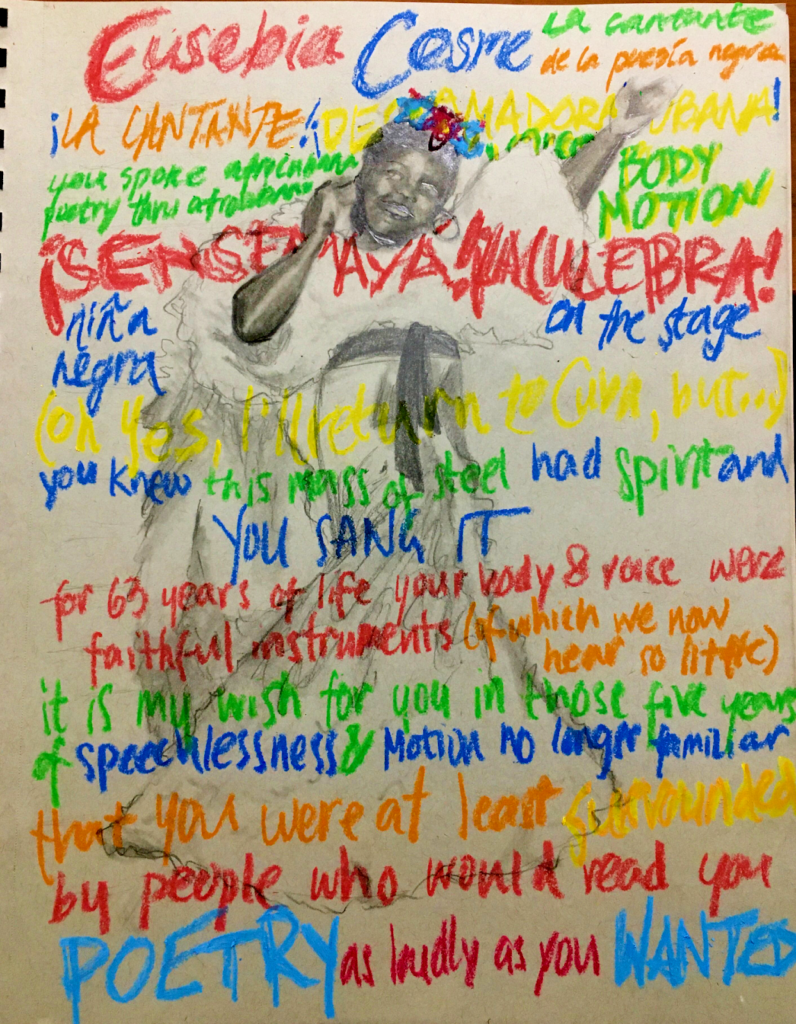
I want to share a piece I did in charcoal and oil pastels in response to learning about Eusebia Cosme Almanza, a brilliant Afro-Cuban artist. Born for the stage, she was denied a chance at real acting roles due to racism, but became a master of the art of reciting poetry, with a focus on poetry that talked about the Black experience and African diaspora.
In the last five years of her life, Cosme Almanza had a stroke that left her unable to speak. There are very few records of her life from that time, so we don’t know much about how she was treated. This artwork was me reaching back into the past and sharing my hope for her: that even when she could no longer recite the poetry she so loved, the people who cared for her would still honor her love for art and her flair for the dramatic that made her one of Cuba’s most beloved voices.
Marrok: Overall, how did getting your access needs met during your degree go?
Ren: All universities have to have a disability services office, and I was familiar with them, but I also did not have many formal diagnoses at the time. I did not—and still do not have—a formal autism diagnosis, nor do I ever intend to get one, and my complex chronic illness was also undiagnosed at the time. It can be difficult to get the accommodations you need even with the right diagnoses, but without them, it is an uphill battle, as I had learned as an undergrad.
Not everybody was so ready to make it possible for me to participate in grad school, either!
I have some access to speech, but it is often inadequate (not enough to say what I want to say) and unreliable (what I do say isn’t always what I mean). I strongly prefer typing to communicate (and there are times when I do not have speech at all, especially when I am stressed or feeling very sick).
One of my professors just refused to look at the Zoom chat during classes. I sent them email after email, and they would promise to do better, and then nothing changed. Classmates with access to speech would regularly get called on just to say, “Ren is speaking in the chat.” They would wait expectantly until I was acknowledged, and would redirect conversation to make sure I was not ignored. I am so thankful to them. People who refuse to change the way they do things will always exist, and it is allies like my classmates that make it possible for people with speech-related disabilities to participate anyway.
But they shouldn’t have had to do that for me, and I shouldn’t have had to endure that stressor every week. Not only was it a reasonable request—all I asked was to be heard—but this professor is well-known in disability studies! I was baffled, and so much more insulted than I would have been if this person had not had any relationship with the disability community. They should have known better.
Marrok: What would have improved your access?
Ren: Access to good healthcare. Outreach from the disability services office. Better experiences throughout my college career with disability services—the knowledge that these were people I could trust to support me, no matter my circumstances. I didn’t have these things, but I did have my community—my classmates and allies. In an ableist world, it’s these allies that make it possible for us to participate.
Marrok: Why do you think graduate schools should put in the work to make their programs accessible for people with speech-related disabilities?
Ren: Earlier I said that graduate school is about asking the question, “How can I be a part of this conversation?”
People with speech-related disabilities ask this question, too. We are always trying to be part of the conversation, in a million different ways, many of them unrecognized. We have so much to say about everything, and the topics of academia are no exception.
When graduate schools give us a chance to participate in the conversation, they will find that we are bursting with curiosity, opinions, thoughts, ideas, and wisdom. We enrich the exchange of knowledge. Without us, the conversation will always be missing something crucial.
Download post in PDF form here. Access post via Google Doc here.
Image Descriptions:
[Image 1: Headshot of Ren Koloni accompanied by a quote. It says, “We are bursting with curiosity, opinions, thoughts, ideas, and wisdom. We enrich the exchange of knowledge. Without us, the conversation will always be missing something crucial.” Ren’s name and the CommunicationFIRST logo are below their quote.]
[Image 2: digital collage poem made by Ren Koloni, one of many created for their essay honoring unseen disabled ancestors. It is centered around a portrait of a young white boy with a kind face and small smile. The poem, constructed of lines from the young boy’s description, is overlaid on top of the portrait. It reads, “aged 9 years / in general, prefers sitting; / sometimes utters / —de de de; / a little mischievous; / fond of hearing music, / exhibits affection for a patient / in the Asylum who is kind to him;”]
[Image 3: Art by Ren Koloni, which includes a photograph of a realistic black-and-white charcoal drawing of an Afro-Cubana woman, smiling and dancing. Layered behind and on top of her are words in bright, colorful pastels, reading: “Eusebia Cosme, la cantante de la poesía negra, ¡la cantante! ¡declamadora cubana! You spoke afrocubana poetry thru afrocubana voice / body / motion! ¡Sensemaya! ¡La culebra! Niña negra on the stage. (Oh yes, I'll return to Cuba, but...) You knew this mass of steel had spirit and you sang it. For 63 years of life your body & voice were faithful instruments (of which we now hear so little). It is my wish for you, in those five years of speechlessness and motion no longer familiar, that you were at least surrounded by people who would read you poetry as loudly as you wanted.”]