
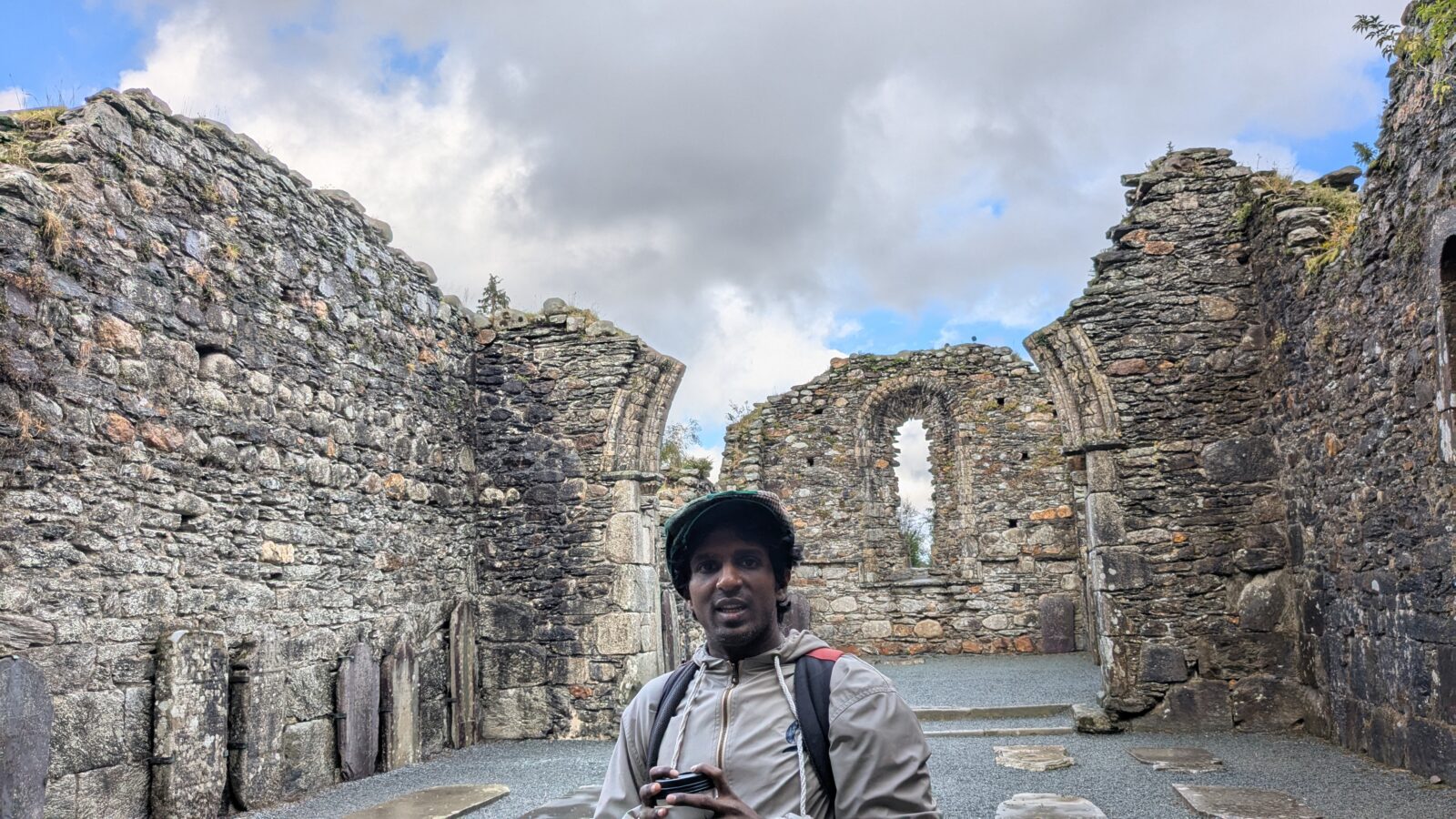
 Guest Blog by Hari Srinivasan
Hari Srinivasan is a Neuroscience Ph.D. candidate at Vanderbilt University researching sensorimotor systems in autism. An autistic and ADHD thought leader who navigates spoken communication challenges, he brings personal insight to his scholarship and writing.
Our community needs technology that works with us. For many of us, communication technology is not optional; it’s how we are heard, understood, and included. Too often, these systems are built around assumptions of what communication should look like, rather than how it actually works for the people using the systems.
This creates a quiet mismatch. It shows up in small, everyday ways, when something simple takes longer than it should, when meaning gets lost, or when being understood depends on how well you can adapt to the system instead of the system adapting to you.
At the root of this is how artificial intelligence (AI) systems are built. They are trained on data from people who speak fluently, consistently, and in predictable ways. They are optimized for speed and what is most common. When communication looks different—slower, effortful, or shaped by motor and sensory differences—it is often treated as error rather than variation.
This leads to what I call engineered exclusion: systems that consistently sideline certain forms of communication because of the assumptions built into them. You can see this most clearly in what it takes just to be understood.
Getting something to “sound right” using text-to-speech (TTS) can mean typing it in ways that look wrong. Acronyms don’t behave the way you expect. We live in a world where terms like AI and ML, or “machine learning,” are everywhere, but when using TTS, “AI” comes out as “aye”—like a pirate saying aye aye, captain—and “ML” turns into milliliters. This absurdity is our everyday reality. Even the most familiar terms break down. Many of us have spent a huge portion of our childhood years in Applied Behavior Analysis (ABA) therapy, yet “ABA” has to be written as “yay b yay” to be understood, and even that doesn’t sound quite right. In my neuroscience work, I use EEG for neural data. To make it intelligible, I have to type it as “ee ee g.” Otherwise, the TTS system treats it like a word and produces something that sounds like a cross between shrieking and choking.
So I am forced to adapt. I add spaces. I rewrite words phonetically.
I also have to remember what works and what doesn’t. For example, I use both the terms VR (virtual reality) and AR (augmented reality). VR works fine. AR doesn’t—I have to spell it as “yay R” or say the full phrase. It’s like learning another language with inconsistent rules, and switching between that and regular English on the fly.
This turns communication into work. For many minimal and nonspeaking people, every message already takes attention, motor planning, and time. When technology adds corrections and guesswork, it compounds that effort. The burden shifts onto the user, rather than the system.
And when communication takes this much effort, it changes how you participate. Conversations become harder because of the extra thinking required to make yourself understood. You’re not just communicating—you’re planning workarounds in real time.
Over time, that adds up. Do you blame people for stepping back? For speaking less? For giving up on conversations requiring this much effort just to participate? When that happens, people stop using the tools that don’t work. From the system’s perspective, that doesn’t look like failure. It looks like “refusal,” low usage, or user preference. So the problem disappears not because it’s been solved, but because it’s no longer visible. This creates a loop. Systems continue to work well for those who already fit the system’s built-in assumptions, while others fall out of the data that could drive improvement. The less visible the problem becomes, the less likely it is to be fixed.
This pattern—engineered exclusion—is not inevitable. It comes from how systems are built, which means it can be changed. In my recent paper, I explore what it would look like to move in that direction—toward what I call designed dignity: systems that recognize and support different ways of communicating from the start, rather than forcing people to adapt after the fact.
Ultimately, this is not just a technical issue. It’s about what counts as communication—and who gets to decide. If systems are designed around a narrow idea of communication, inclusion becomes conditional.
But communication has never been one-size-fits-all. It can be paced differently, expressed through movement, or supported through multiple forms at once. Technology should expand to meet that diversity, not compress it.
Technology built around assumptions about autistic communication often falls short. We need technology designed with us and built to work for us.
Because being heard shouldn’t depend on how well you can fit into the system. The system should be able to meet you where you are.
Download post in PDF form. Access post via Google Doc.
Image Description:
[Image: Wearing a dark cap and light brown jacket, Hari Srinivasan stands inside stone castle ruins along the coast of Northern Ireland.]